
The smartest thing about Payroll Savings? You barely notice it's working
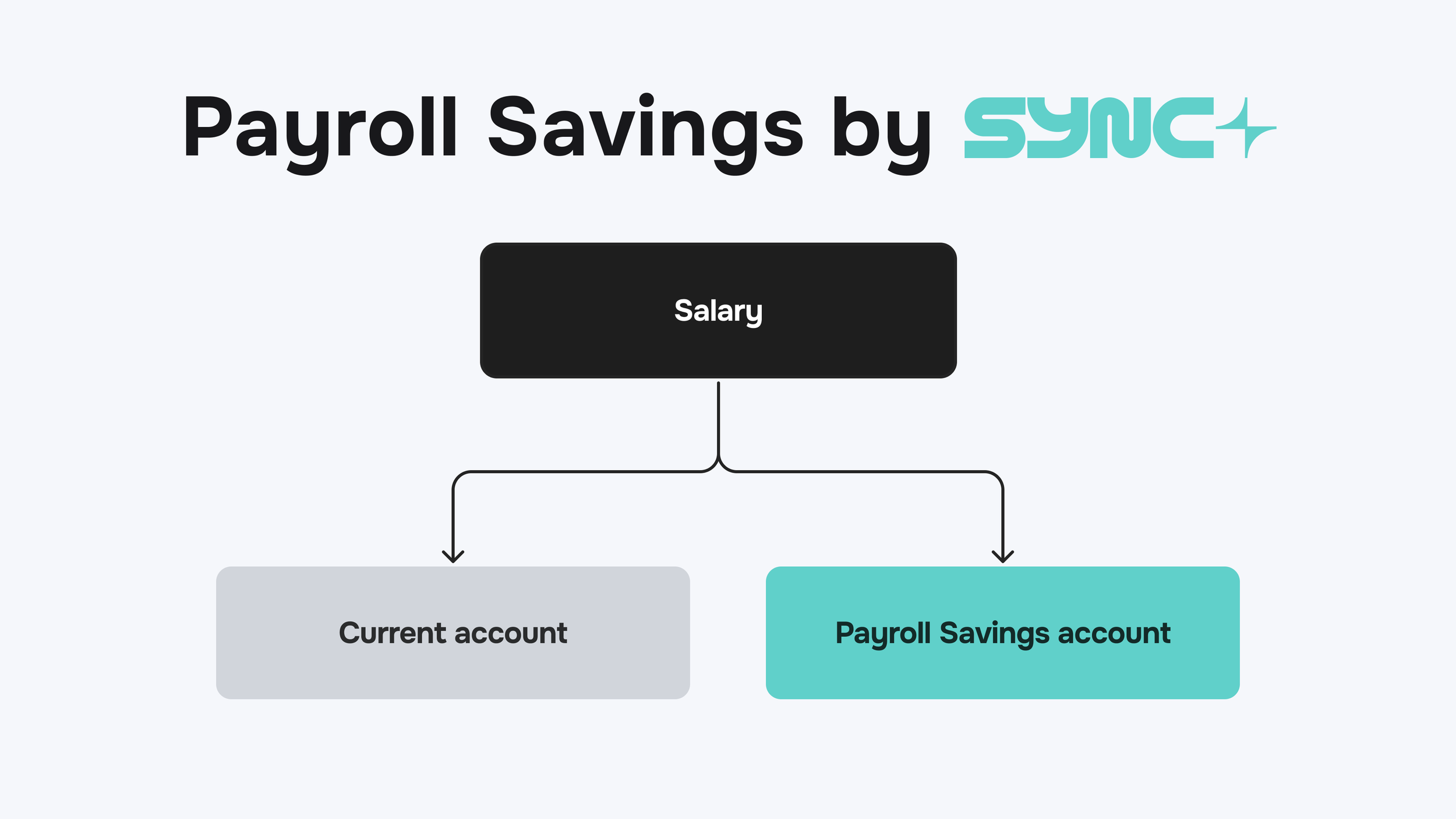
Recently, we spoke to hundreds of savers about how they manage their money and we noticed something remarkable.
The ones who save consistently (and consistency, not perfection, is key) have nearly all arrived at the same behaviour, independently of each other: they move money out of their current account the moment they get paid. They are not saving from whatever's left at the end of the month, or when they randomly remember. They employ the "pay yourself first" approach, immediately, on payday, before they've spent anything.
“I like to move savings money to another account. If it is in my current account it will be used up. If it is in another account I don’t consider it my money anymore and I am very reluctant to spend it.”
“I set apart the savings immediately after I get paid. I try to use only what I have on my current account.”
“On payday each month I move a specific percentage into various savings accounts… I know how much my bills are and work around that.”
Through trial and error each of these savers has discovered the same psychological principle: money you can see is perceived as “available to spend”. Money that's somewhere else starts to feel like it belongs to a different category entirely. Out of sight = out of mind, or at the very least, certainly not spending money.
What they're doing instinctively and manually is exactly what Payroll Savings does effortlessly and automatically.
The "save what's left" approach fails almost everyone
The counterpoint in our research was just as consistent. People who hadn't found that rhythm described a familiar cycle with nothing left to save at the end of the month after bills and expenses, and consistently unable to save.
These people aren't "less disciplined", but rather unconsciously setting themselves up to fail. Saving at the end of the month means money sits in your account, visible and available for weeks, competing with every need or temptation just to not be spent. Behavioural economics suggests that in this circumstance “present bias” means the odds of saving are severely stacked against you - humans have a tendency to weigh immediate needs far more heavily than future ones. The longer money is visible, the more reasons to spend it appear!
The people saving successfully have found a workaround whether they realise it or not: remove the money you intend to save from view immediately and let your brain recalibrate to the remainder, spending only within that budget.
People don't treat money as fungible
Humans - we’re a funny bunch! And to most human of us, not all pounds feel like the same pounds. In other words, people mentally “label” their money instead of seeing it as one big, interchangeable pot. Rent money feels different to holiday money. A bonus feels different to salary. Even though, in theory, every pound has the same spending power, we don’t actually behave that way.
Behavioural economist Richard Thaler referred to part of this concept as mental accounting - the way we unconsciously categorise and value money based on where it's held rather than just how much of it there is. A pound in your current account and a pound in a separate savings pot are technically identical, 100% interchangeable, "fungible", but they don't feel identical. And that feeling is what drives behaviour.
Once money is separated somewhere else and no longer immediately visible, it stops competing to be spent. People in our research described this shift clearly with strikingly similar language: "I don't consider it my money anymore", as if the transfer had changed the nature of the money itself, not just its location.
This is one of the reasons Payroll Savings is such an effective mechanism for saving. A fixed amount is deducted directly from your pay before it reaches your bank account (the same way pension contributions do). When you open your banking app to receive your salary you see the amount, net of your savings deposit amount as if it was never even there! Your mental baseline sets itself around what landed, not the total of your pay packet.
One of our savers described it this way: "Saving straight from my pay makes it effortless - I hardly notice the money leaving, but it really adds up over time."
Effortless is the key word. The people manually moving money on payday are achieving the same thing, but it still requires remembering, deciding, and acting, every month, without fail. Even the busy months and the stressful months. Even with standing orders and manual automations, you see the money leaving your account and loss aversion kicks in.
Pensions are proof this method is incredibly impactful
There's one form of automatic pay deduction almost everyone has experience with: the workplace pension.
And the way people talk about their pension contributions in our research is revealing.
“I have contributed to a workplace pension for over 25 years. I do not consider this money to be mine. It is taken from my salary so I don’t have to make any effort to move it or resist spending it.”
Twenty-five years of not missing money that was never in their account. Again, not because of olympian discipline, but because the mechanics make the money invisible from day one, so you neither feel nor see the sting.
The same is true of student loan repayments. Anyone who's repaid a student loan through payroll knows that after the first month or two, it simply disappears from your sense of what you earn. You don't budget around it or resent it (not always, anyway). You just think of your take-home as the number that lands in your current account. It's something we've written about before - the student loan mechanic is one of the clearest real-world demonstrations that payroll deductions reshape your mental picture of income.
This is the experience that translates directly to Payroll Savings. Set up a monthly contribution of, say, £100, and within a very short time, when you think about your salary, you think of it without that £100. It's not a conscious adjustment but your mental picture of what you earn simply recalibrates around what lands in your current account. The saved amount disappears from your sense of available income, just as pension contributions do, just as student loan repayments do.
The difference with Payroll Savings is that you can actually access that money at any point. It's building into something you can use – an emergency fund, a goal, a financial cushion - not locked away until retirement, or spent paying off a debt.
Automation isn't about losing control. It's about removing the decision.
One concern that came through in our research was the fear of losing control - the sense that managing your own money (manually!) was part of being on top of things.
That instinct is understandable, but the people who save most consistently in our data aren't the ones who track everything most carefully. Instead they're the ones who removed the monthly decision entirely and trusted a structure and let it run.
Workplace Savings means less effort to achieve the same result, maintaining the same level of control, and with a consistency that willpower alone rarely sustains. If life changes (an expensive month, a shift in priorities) contributions can be paused or adjusted at any time. Flexibility and control. Always!
Want to bring this to your team? Book a demo with Sync Savings and see how Payroll Savings could work for your organisation.
